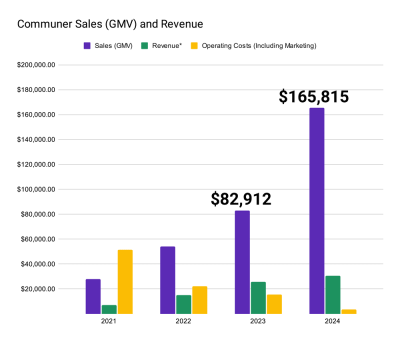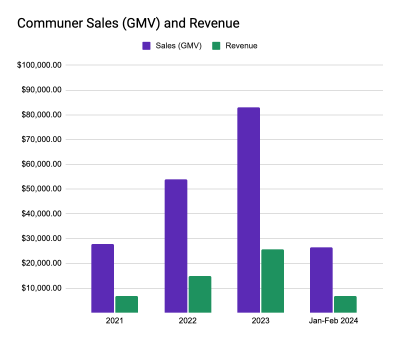
On June 28 we passed last year’s total sales of $83,000.00, ending the first half of 2024 with just over $85,000 in sales.
This growth was a surprise to me because we’ve never doubled our sales in a year before and I had no reason to believe we’d do it this year. I was fine with the 50% annual growth we seemed to be steadily getting each year, especially given that we discontinued all paid ads late in 2023.
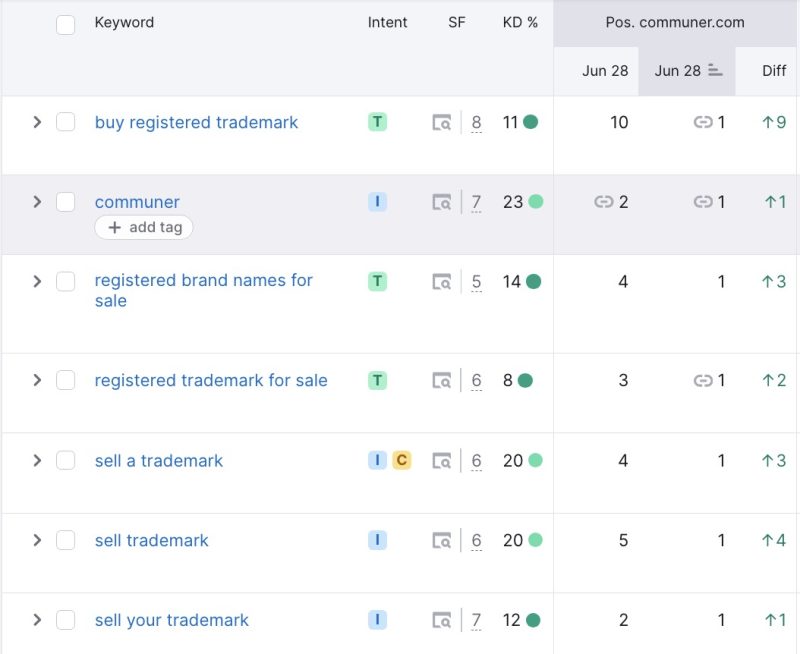
I attribute this growth primarily to a huge improvement in our search engine rankings. We now rank #1 on Google for a whole bunch of relevant keywords like “sell a trademark” and “buy trademarks,” driving about twice as much search traffic to our site as we were getting a year ago.

Now that we’ve conquered most of the obvious terms like “trademarks for sale,” “old brand names for sale,” and “how much is my trademark worth,” the next step is to capture non-trademark-related keywords dominated by fake “brand name marketplaces” that actually sell domain names, not brand names.
These new target keywords include “buy a brand name” and “brand names for sale” (we’re currently #13 for both) as well as “business names for sale” and “value of a brand” (we don’t rank at all for either one).
Organic Growth Tactics for Our Marketplace
After being dependent on Google Ads for the growth of my law firm, it feels great to be growing Communer purely through organic means. Google Ads are an albatross around the neck of any startup. Tying your growth to Google Ads means signing a duopolistic deal with the devil that yields diminishing returns over time as more competitors bid against you for the same keywords.
Here I’ll briefly touch on some of the growth tactics I’ve used to grow Communer’s reach. Some of them are merely stunts or “growth hacks.” Others might be described by Moz founder Rand Fishkin as “marketing flywheels,” which take a lot of time and effort to get going, but gain momentum over time.
1. Asking Sellers to Link or Redirect to Their Listings
When somebody lists a trademark on Communer, we typically recommend they put a note up on their website saying “This brand is for sale on Communer” with a link to the listing. Additionally, some of our sellers are no longer using their domain names at all when they list on Communer and we ask them to forward their entire domain to their brand name listing.
This is a great tactic for promoting a listing because many people who are trying to come up with a brand name type the matching .com domain into their URL bar to see if it’s available. It’s also a great tactic for improving Communer’s search engine rankings because each link or redirect from a seller’s website might improve our domain authority.
2. Selling Document Templates and Legal Guides to Relevant Audiences
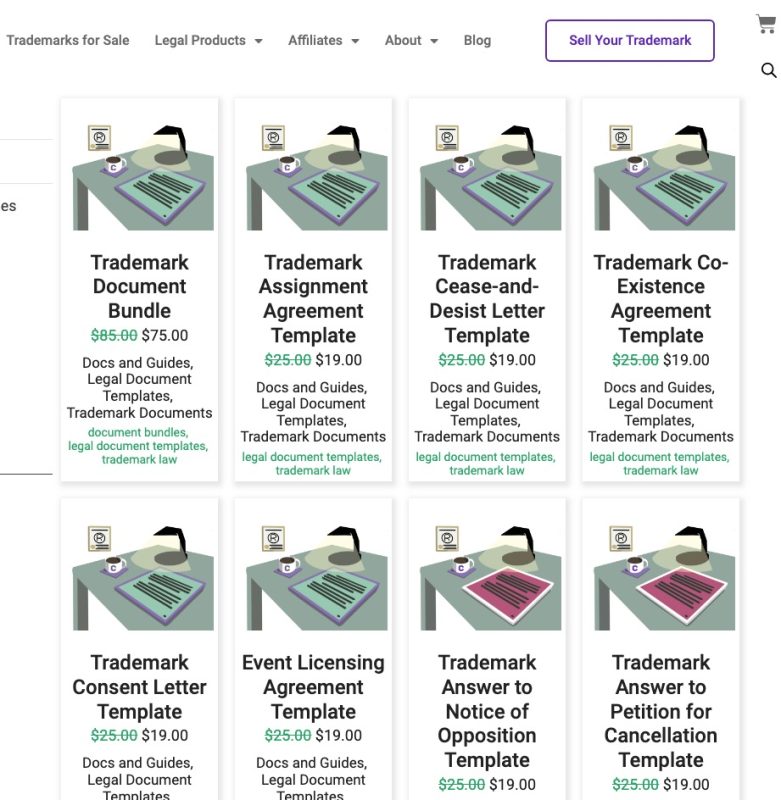
In addition to trademarks and domain names, we offer legal document templates and legal guides for sale on Communer, mostly relating to trademark law. These products do pretty well despite no active marketing because we’re often the only relevant search result for obscure keywords like “TTAB Motion For Default Judgment, Failure to Answer.”
While sales of docs and guides only make up about 4% of our revenue, they bring a lot of traffic to our website from relevant visitors like trademark attorneys and trademark applicants. This builds awareness among people who are likely either to come back later to buy or sell a trademark, or to recommend us to a colleague.
3. Referring Customers Between My Two Businesses
My other business, JPG Legal, is a high-volume trademark law firm. JPG Legal’s clients and website visitors are a highly relevant audience for both sides of Communer’s marketplace model (buying and selling), given that JPG Legal’s users often want to register trademarks or already own them.
JPG Legal spends about $10k a month on Google Ads. That spending more than pays for itself in new clients, but it also leads many visitors to Communer through the “Trademarks and Domains for Sale” link on the website’s navigation bar. So while I don’t spend money directly on ads for Communer, I do attract relevant users as a byproduct of my other business’s ad spend.
At the other end of the funnel, my law firm handles around 60 trademark applications and 15 trademark renewals a month. I’ve set up automated email reminders to let clients know when their trademark applications have reached registration and when their registrations are a year away from their renewal deadlines. This reminder also lets them know that they can list their trademark for sale on Communer.
In exchange, Communer refers trademark buyers and sellers to JPG Legal for trademark renewals and assignment recordations. These referred clients often come back to JPG Legal for other trademark filings.
I realized recently that even if Communer were only breaking even and couldn’t pay me a salary, its existence could be justified by all of the revenue it generates for JPG Legal. By creating Communer, I’ve set up a marketing flywheel for JPG Legal, giving me another free source of clients for my firm.
4. Recruiting Affiliates (Through Postcards and Other Means)
Communer has a great affiliate program. Affiliates get 25% of what we get for any purchases made through their referral links or coupon codes. Some of our affiliates are branding agencies and business consultants, while some of them are just bloggers.
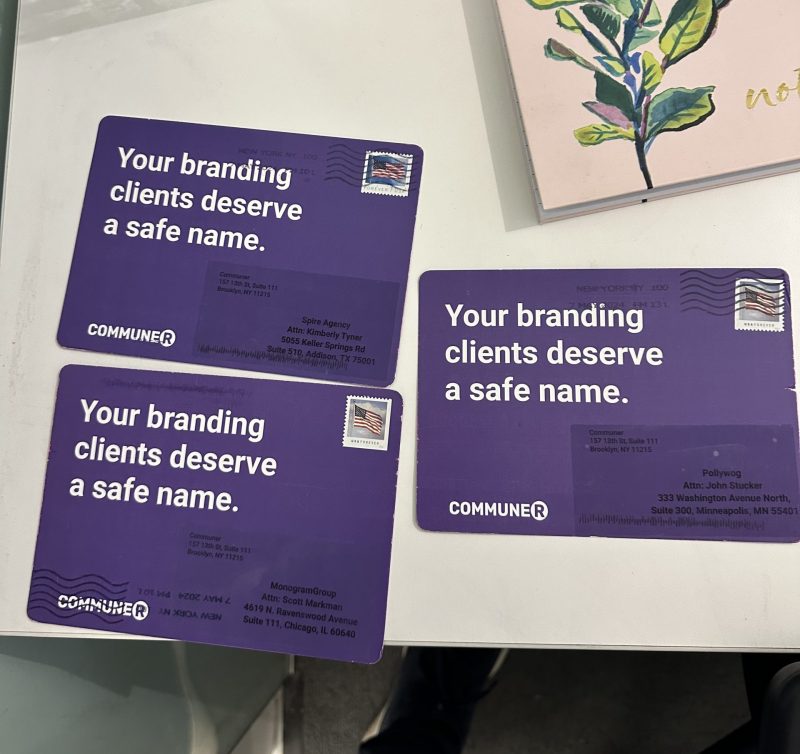
Stephanie and I have been sending postcards to branding agencies trying to make them aware of the trademark aftermarket as an option for their clients, while also touting the affiliate program.
5. Guest Posts, Press Coverage, and Blogging
As fun as all the other stuff is, building links through conventional means is still one of the biggest contributors to our growth right now. This includes writing guest posts, getting cited by journalists and bloggers as an expert, and garnering press coverage.
We also get organic search traffic by writing blog posts that target keywords we have a good chance of ranking well for.
Finally, I like to think that Google Search is rewarding us with higher rankings because it has figured out that we’re the only good option for what our customers are looking for when they want to buy or sell trademarks.
6. Cybersquatting Stunts (Returning to My Roots)
Before I was an IP lawyer, I was an IP squatter and I got a lot of press coverage for it as well as some money.
Rachel Maddow discusses my comics on ClintonKaine.com on the day Clinton chose Kaine as her running mate. I sold the domain a few weeks later.
I never stopped buying political domains, so for the 2024 election cycle I had a bunch of domains ready. However, instead of listing them on a domain marketplace like Sedo, I listed them on Communer. No, they’re not trademarks, but Communer’s infrastructure still made it a great place to list them as a publicity stunt. The domains themselves take visitors directly to the Communer listings.
This tactic has had some success, driving a lot of traffic to my listing for TrumpCotton.com when Tom Cotton was on the short list to be Trump’s running mate.
Now my 15 Harris domains are in play. I own domains for three out of eight of the potential running mates who have received vetting materials from her campaign: HarrisPritzker.com, HarrisWalz.com, and HarrisRichmond.com. My listing for the bundle of Harris domains has been bringing in significant traffic since Harris became the de facto nominee a few days ago.
Will this traffic matter much? Maybe not, but if Harris does pick one of the three contenders who match my domains, I’ll probably get at least a few news stories about Communer with links. Especially if I summon the energy within the next week or two to put something interesting up on these domains.
If I get even 10% of the coverage I got for my Clinton domains in 2016, it should result in a noticeable boost for Communer’s search engine authority.
One of my other Clinton domains, ClintonBooker.com, got a good amount of press coverage too, giving it solid domain authority. It has links to my businesses in addition to the comics I originally had on it.
Next Up: Free Web Tools
As I’ve built our internal software tools for verifying, appraising, listing, and transferring trademarks, I’ve become a more confident coder, especially with Python. I’m now working on a free consumer-facing version of our Markhound® Appraisal tool that will tell any interested visitor to our site what their trademark is worth in just a few seconds, with no email signup required.
Releasing such a useful tool for free will hopefully attract visitors and maybe get some attention from branding and marketing blogs. At the very least, it should draw in the hundreds of people searching for terms like “trademark appraisal tool” and “How much is my trademark worth?”