Communer has never been my full-time job, and often it’s not even a part-time job. Some weeks I’ll spend 15 hours on it, and other weeks I’ll put in one or two hours.
In the months leading up to the birth of my second kid in January, I focused what time I could on automating more and more of Communer’s processes by writing and deploying software programs to handle every part of the trademark listing and purchase process.
This paid off because once my son was born, I had to divide my time between my main job — running JPG Legal — and feeding and changing a baby that never slept more than two hours straight for the first couple of months, while keeping his well-meaning older sister from killing him or waking him up.
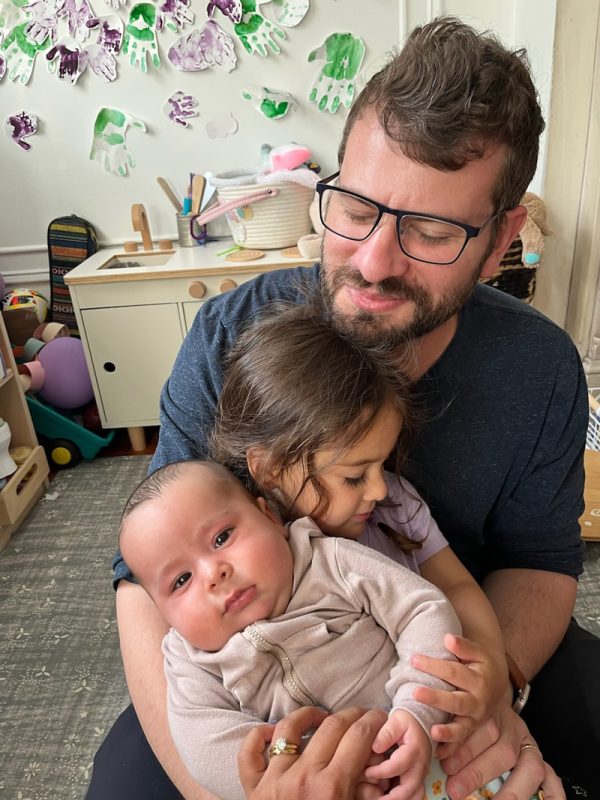
As you can tell by the picture above, we succeeded at feeding that baby. He’s very fat, much fatter than his sister was at the same age. It’s impressive considering he was only 6 pounds 8 ounces when he was born. My wife deserves most of the credit though.
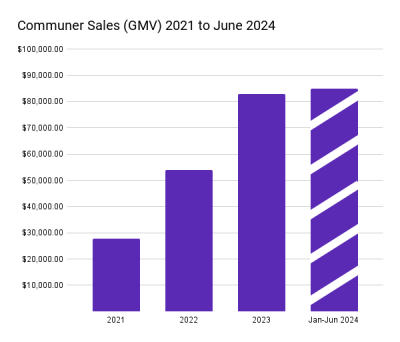
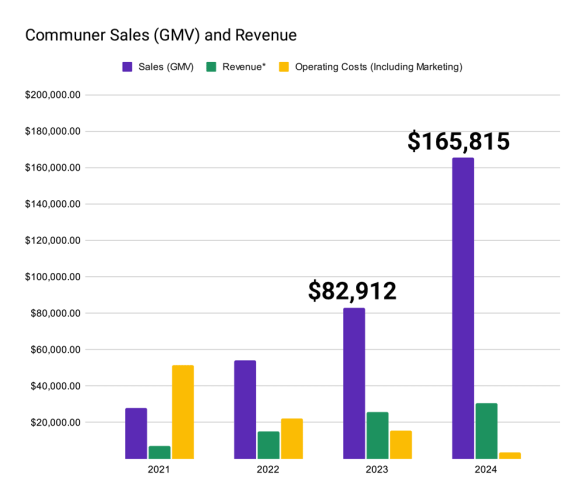
Communer has also gotten impressively fat considering how little time I’ve spent on it and how little money I’ve raised so far ($0). Sales went up by exactly 100% from 2023 to 2024, from $82,900 to $165,800.
I also stopped all spending on ads in mid-December of 2023, which should have led to a decrease in sales, or at least a decrease in growth. This makes the doubling of sales in 2024 even more surprising.
But like my fat son, Communer is still a baby. My law firm was at $1 million in annual revenue only two years after I launched it in 2017, so it’s been frustrating to see Communer remain so small, even though I’m very happy that it doubled last year. I have to remind myself that my law firm followed an established business model in a large market, and that I spent quite a lot on ads for the first several years, resulting in margins that I later learned were unsustainable until I eased off of the gas pedal with my ad spend.
Communer, on the other hand, is creating a new industry out of nothing. It still doesn’t occur to most businesspeople — especially when they’re trying to come up with a brand name — that they can buy or sell “dormant” trademarks online, and why it would be desirable to do that. The closest thing people do is go to domain name marketplaces and see what’s available, which is really the opposite of what you should do. It’s also a great way to get sued.
But enough about how tiny Communer is. A 100% increase in sales with no outside funding, in my first year with no ad budget, is worth both celebrating and dissecting.
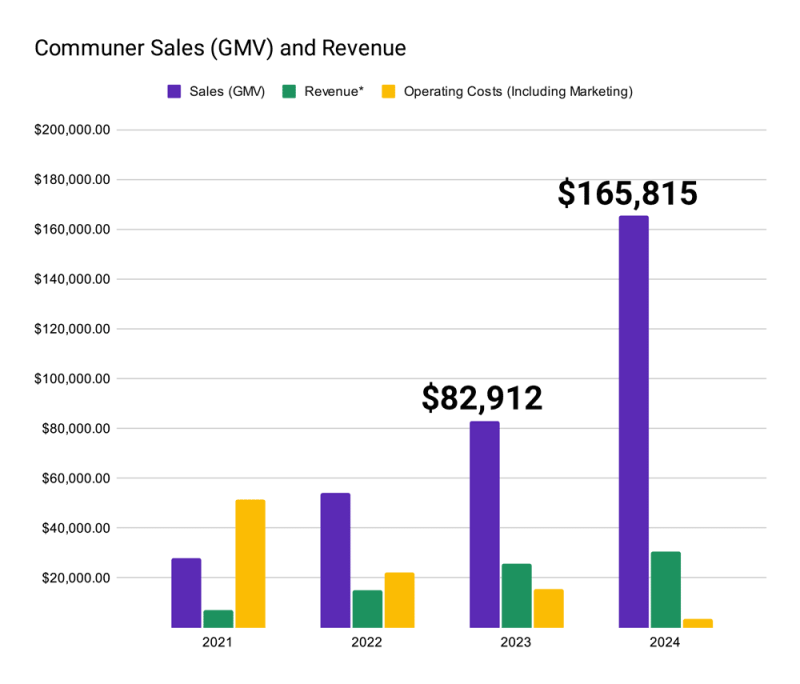
Perhaps more impressive than the 100% increase in sales was my 77% decrease in operating costs, from $15,000 to $3,500. Now that I spend no money on advertising, my only costs are software-related.
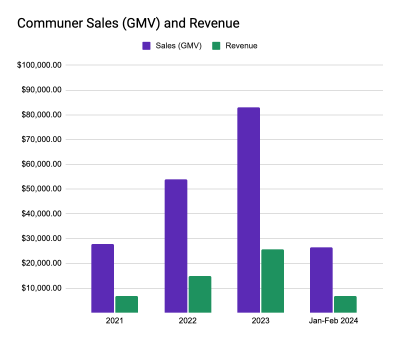
So even though Communer’s revenue only increased 19% (we took a revenue hit when we slashed our pricing almost in half), I personally made about twice as much income from Communer for my owner’s draw. Yes, that’s only $27,500 before taxes, but for something that pretty much runs itself when I’m too busy to work on it, it’s a good return.
It’s also scaleable. Even if Communer gets 10 times as big, the operating costs shouldn’t get any higher than $4-$5,000. With fixed costs and projected future growth, Communer has the potential to be a genuine cash cow for me.
Here are my explanations for the doubling of sales last year:
Reason # 1: Tons of Tangential Press Coverage

I have a dumb little hobby where I buy domain names consisting of two people’s last names, hoping to correctly guess an upcoming presidential ticket. So far I’ve succeeded twice: once in 2016 with ClintonKaine.com (I bought it in 2011) and then again last year with HarrisWalz.com (I bought it in 2020).
So when Biden bowed out of the race and endorsed Kamala Harris for the Democratic nomination, I threw all my best Harris domains up on Communer (and my best Whitmer domains just in case). I also put the most zeitgeisty thing I could think of up on my two best Harris domains, one of which I still own.
The resulting press coverage was absolutely crazy. I did about 25 TV, phone, and video interviews over a week-and-a-half stretch. About half of the 50 or so news articles about me linked to the Communer listing for the domains, usually with a brief description of Communer and a link to the main page. This included about 50 NPR affiliate websites covering my second appearance “Morning Edition” eight years after my first time on the show and my interview on the Canadian show “As It Happens”.
This coverage bumped Communer up a notch in the search rankings. Not as much as I would have hoped, but still enough to make it start showing up in the top few results for terms I had never ranked for before.
Separately from improving my Google page rank, this press coverage also brought a lot of traffic and publicity to Communer, greatly raising brand awareness. People were even watching footage of me in my office scrolling through my website on Japanese TV news!

Reason #2: Lowering Communer’s Sales Commission to 15% (Previously 25%)
I was inspired by a blog post by investor Bill Gurley to reduce Communer’s commission on each sale from 25% to 15%. I implemented this change on March 1 of 2024.
This has, of course, made sellers more willing to list on our website and happier with their sales outcomes. But on top of that, it has also resulted in lower prices on our marketplace, prices much closer to the “true” values of these brands, now that sellers don’t have to factor a large commission into their pricing decisions.
Before then, I had told myself that 25% was still less than many domain name marketplaces charge, and that we provide legal services for free that they don’t. There’s also no other marketplace that does what we do — handling the entire sale process of trademarks from due diligence to legal transfer — so I thought a high-ish rake was reasonable because we’re the only option.
However, reading Gurley’s blog post made it clear to me that I was leaving Communer vulnerable to new competitors, possibly funded by venture capital, by not making my commission structure as competitive as possible. I was also creating a lot of friction for both sides of my marketplace. When the rake is as substantial as 25%, it leads buyers and sellers to look for ways to transact outside of the marketplace. Bringing it down to 15% makes selling within the marketplace a no-brainer, given all of the compliance and logistics support we provide for the transaction.
However, lowering the commission by 40% dramatically reduced my revenue in the short term and changed the economics of Communer for me. Before the change, I could justify spending a lot of time handling the listing process and the sales process, because I made a good amount of money from each sale.
After the change, I made a lot less from each sale, incentivizing me to build a ton of software that automated what I was doing manually. It now takes me maybe 10% of the time it used to take me to verify each trademark’s validity and seller identity, appraise each trademark, list each trademark and generate marketing copy, and facilitate the legal transfer of each trademark from the seller to the buyer.
Now I make 60% of the money per transaction while only doing 10% of the work. I had always planned to automate all of these processes, but the newly-unsustainable unit economics really lit a fire under my butt to speed up that automation process.
This ended up being necessary anyway because now that I have two kids and a surprisingly large workload for my law firm, I currently don’t have time to spend 15 hours on Communer each week like I used to. I probably won’t for at least another few months, until my three-year old starts her free, city-funded 3K program in the fall (one of the many under-appreciated benefits of living in NYC).
Reason #3: Greater Inventory
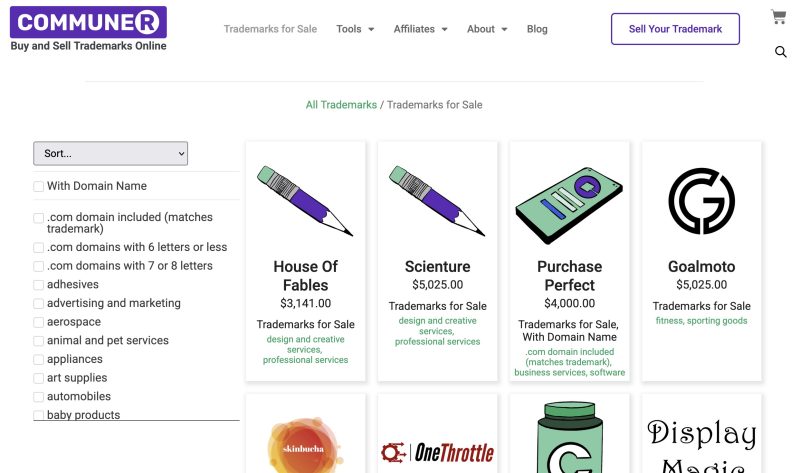
Communer is a marketplace business model, which has benefits and drawbacks. One reality of growing a marketplace startup is that you constantly have to keep growing two separate user bases with different and often-opposing desires, at the same time.
As time has passed, our overall inventory of brands for sale has increased. This has naturally led to potential buyers finding what they want more often when they browse the marketplace.
For a long time at the beginning, I focused on growing inventory, because I needed a solid number of trademarks for sale before we could bother promoting ourselves to potential buyers. Once I had maybe 40 or 50 trademarks for sale, I started focusing on attracting buyers so that existing sellers could get some sales and recommend us to other sellers.
Eventually I started getting enough traffic from people browsing my listings that it became clear people were usually not finding what they wanted because we didn’t have enough inventory. So I had to switch again to attracting buyers.
Creating my free web-based trademark appraisal tool was one of my tactics for doing that. I also got better at convincing clients of my law firm — which handles about 750 trademark applications a year — to list their trademarks on Communer if they were trying to exit their businesses.
Will We Double Again This Year?
We might double this year again, but honestly, we’re not on track to. Unlike last year when I put a ton of work into Communer, this year I’ve only been coasting when it comes to Communer for the life reasons described at the beginning of this post. I think we’ll grow this year, but it likely won’t be dramatic.
I’ve considered trying to raise seed funding so I can treat Communer as my day job. But raising money itself usually requires a ton of time that I could be spending building Communer or making money from JPG Legal, and I’d be giving up the freedom that comes with owning 100% of a company.
Fortunately, I’ll have more time for Communer in a few months as my life settles down a bit. So I don’t think I’m going to spend any time trying to raise money this year, aside from applying to the occasional accelerator.
With that said, if you’re an angel or an early-stage VC interested in investing in Communer, probably with a post-money SAFE, feel free to reach out to me at info@communer.com.